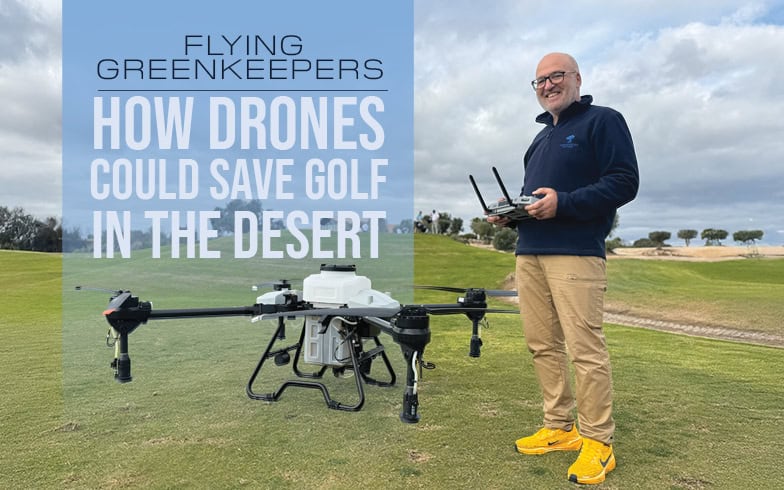
How Drones Could Save Golf in the Desert
Picture this: it’s 3am in Dubai, and while you’re sleeping, a fleet of drones is silently gliding across your favourite golf course, armed not with cameras or delivery parcels, but with billions of microscopic allies that could revolutionise how courses survive in one of the world’s harshest climates.
Sound like science fiction? It’s already happening in Portugal, and it might just be the answer to one of Middle Eastern golf’s biggest headaches.
Amendoeira Golf Resort in the Algarve has become the world’s first course to go full sci-fi with its maintenance programme, combining AI-powered drones with something called “microbiological agriculture.” Before your eyes glaze over at the jargon, here’s what matters: they’re using tiny robots and even tinier bacteria to slash chemical use by up to 80% whilst keeping the course in pristine condition.
For golf courses across the Gulf—where a single 18-holer can guzzle over a million cubic metres of water annually and summer temperatures regularly hit 45°C—this isn’t just clever. It could be a lifeline.
Let’s talk about the elephant in the clubhouse: water. Or rather, the lack of it.
Golf has always had a complicated relationship with H2O, but in the Middle East, that relationship has gone from “it’s complicated” to “we need to talk.” Between climate pressure, government scrutiny, and members who increasingly care about sustainability (yes, even the ones driving Range Rovers), courses are under the microscope like never before.
The traditional approach hasn’t helped. Dump chemicals on the grass, water like crazy to compensate, repeat. It’s a vicious cycle that costs a fortune and makes environmentalists reach for their pitchforks. More chemicals damage the soil’s natural ability to hold water. That damaged soil needs more irrigation. More irrigation means more fertiliser gets washed away. More fertiliser means more chemicals. You get the picture.
What if you could break that cycle entirely?
Here’s where it gets properly interesting. Instead of fighting nature with chemistry sets, Amendoeira is working with it.
They’re introducing specialised bacteria and fungi into the soil—think of them as microscopic greenkeepers. These little critters do several remarkable things. First, they break down organic matter and release nutrients slowly and naturally, which means the grass doesn’t get those growth spurts that guzzle water. Second, they actually restructure the soil from the inside, improving drainage whilst—and this sounds impossible—also helping it retain moisture better.
The Plant Growth-Promoting Rhizobacteria (catchy name, right?) encourage roots to grow deeper, sometimes metres deeper than normal. Deeper roots mean the grass can access water from lower down, rather than depending entirely on sprinklers soaking the surface six times a day.
It’s elegant, really. Healthier soil holds water better. Deeper roots need less irrigation. Natural nutrition means no chemical-induced growth spurts. The turf becomes genuinely resilient rather than artificially pumped up on the golf course equivalent of energy drinks.
But here’s where the real magic happens, and why this matters for courses from Dubai to Doha.
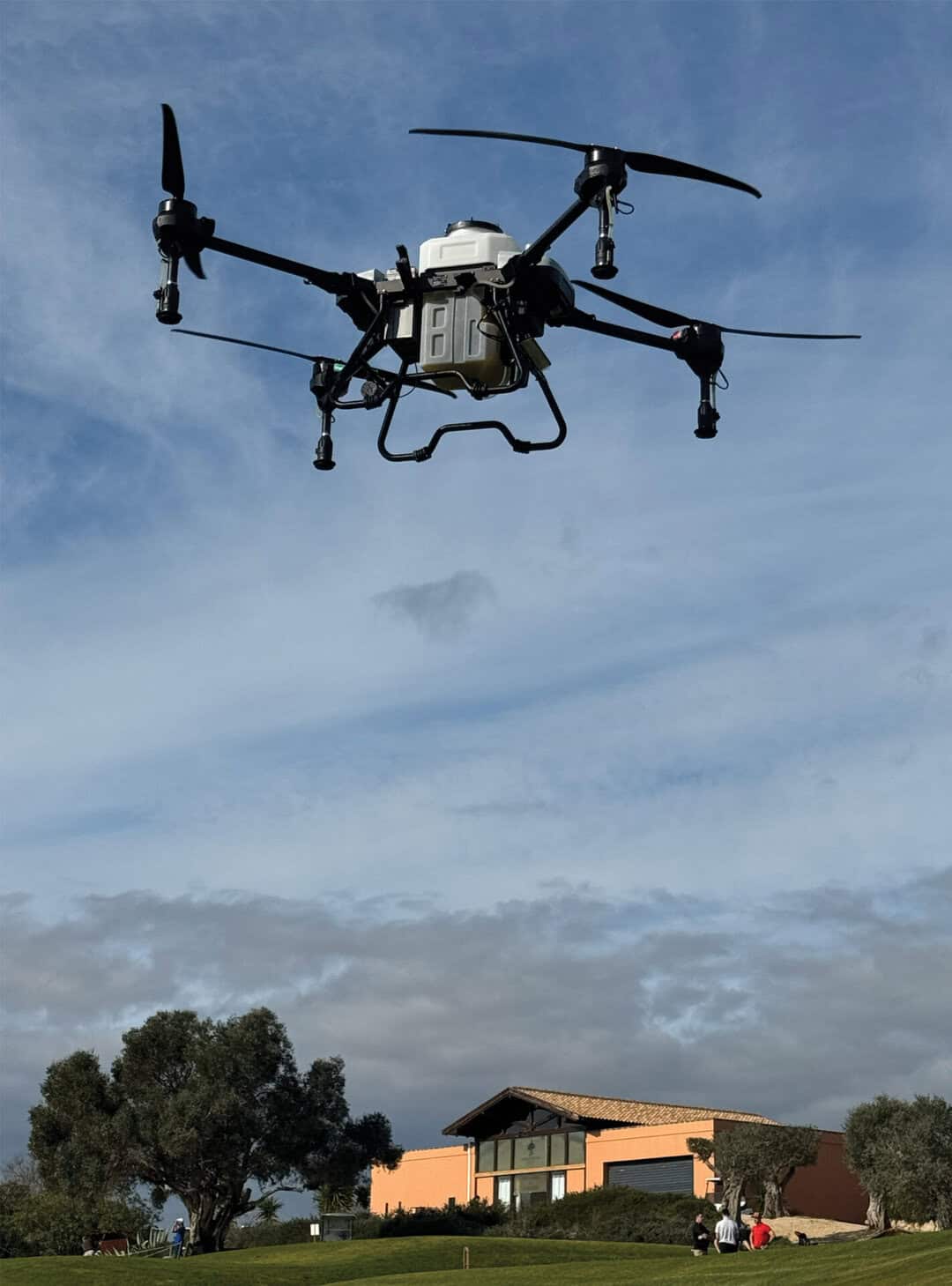
Amendoeira has deployed two types of drones that work as a tag team. The first is essentially a flying doctor with X-ray vision. This multispectral imaging drone sees the course in wavelengths invisible to the human eye, spotting problems before they become disasters.
Water stress? The thermal sensors catch it before the grass starts looking thirsty. Nutrient deficiency? Spotted. Early-stage disease? Identified whilst it’s still treatable with minimal intervention. Pest activity? Located down to the square metre.
For Middle Eastern courses, this is game-changing. When temperatures are extreme, turf can go from “looking a bit dry” to “completely dead” in hours. Catching problems early isn’t just good practice—it’s survival.
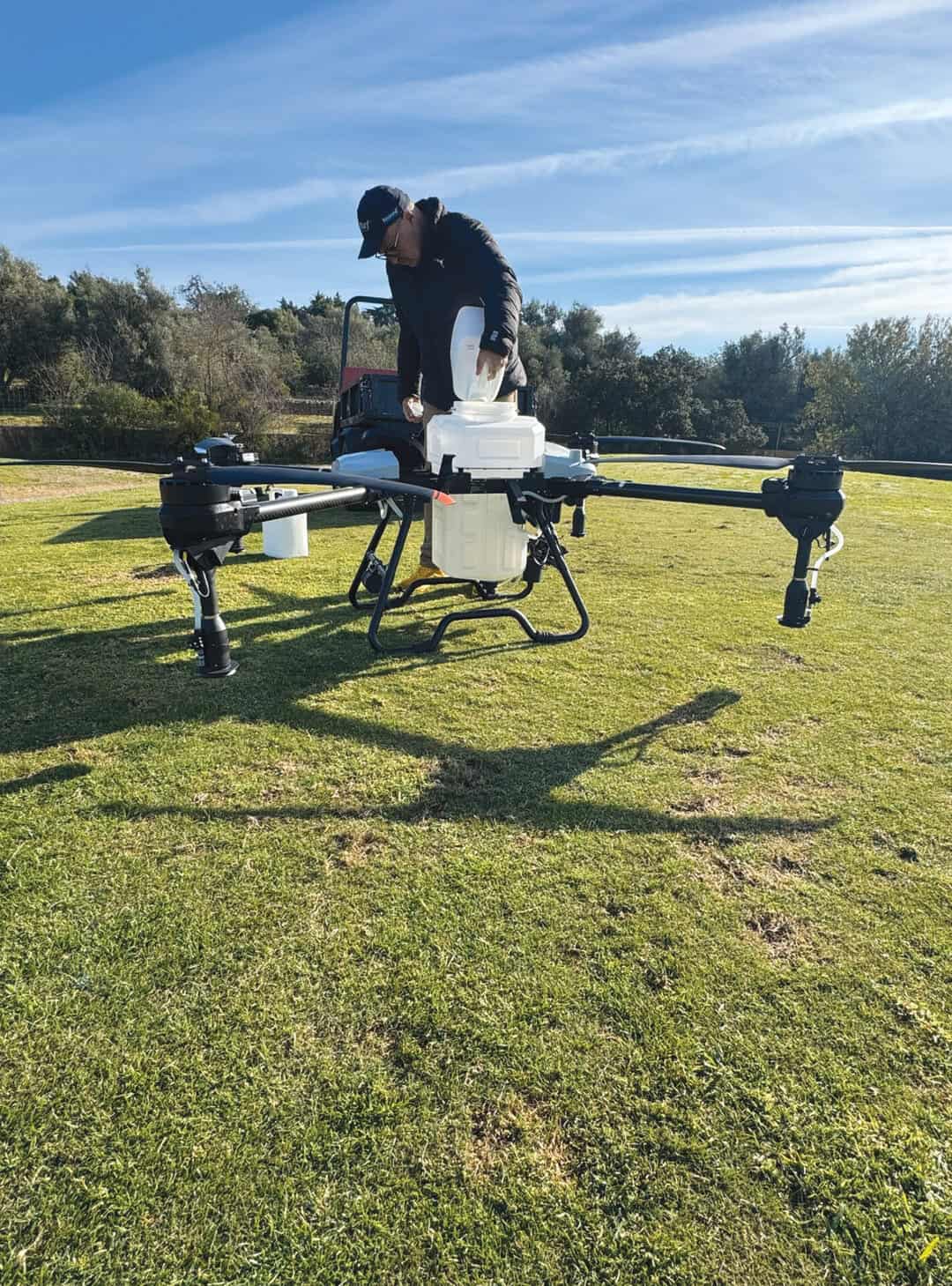
Then comes drone number two: the applicator. Using the prescription maps created by its imaging partner, this one delivers treatments with surgical precision. Not to entire fairways or greens, but to specific patches measured in square metres. It’s the difference between giving everyone in town antibiotics versus treating only the people who are actually sick.
The results? Up to 80% less product used. Dramatically less water needed. And because these drones can fly at night when evaporation is minimal and the course is empty, they don’t interfere with play whilst working in optimal conditions.
Oh, and zero soil compaction, because obviously they’re not driving heavy machinery across your pristine fairways.
Now, you might be thinking: “That’s great for Portugal, but the Algarve isn’t exactly Death Valley.”
Fair point. But that’s precisely why this technology is potentially even more valuable in extreme climates.
Consider the challenges facing courses in the Gulf. Irrigation water is often treated effluent or desalinated seawater—expensive and sometimes salty. Summer heat is brutal. Government regulations are tightening. The UAE wants net-zero emissions by 2050. Saudi Arabia’s Vision 2030 includes serious environmental commitments. Water restrictions are becoming more common, not less.
Traditional greenkeeping in these conditions is like trying to maintain a lawn on Mars. You’re fighting the environment every single day with massive inputs of everything.
The Amendoeira model flips the script. Instead of fighting, you’re building resilience. Those deeper root systems? Crucial when surface moisture evaporates in minutes. That improved soil structure? Essential when irrigation windows are restricted. That 80% reduction in chemicals? It means healthier soil biology that can actually survive extreme heat.
And the precision aspect becomes even more valuable. In Portugal, blanket irrigation might be wasteful. In Dubai, it could be the difference between meeting government quotas and facing restrictions.
Let’s be honest: this isn’t plug-and-play technology. Amendoeira is working with specialists from SMARTSOIL, DataCoLab, and Smart Farm CoLab, and they’re anticipating a three-year transition period. That’s three years of data collection, protocol refinement, and learning what works and what doesn’t.
For Middle Eastern courses, there would be additional challenges. Extreme heat affects microbial populations differently than Portuguese sunshine. High-salinity irrigation water behaves differently than fresh water. Members accustomed to certain playing conditions might need time to appreciate slightly different turf characteristics as the course develops more natural resilience.
But here’s the thing: those three years of learning could slash operating costs significantly, especially as water prices continue climbing across the region. They could future-proof courses against restrictions that are almost certainly coming. They could transform a course from environmental liability to sustainability showcase—increasingly important for hosting tournaments and attracting environmentally conscious members.
You don’t have to be a tree-hugger to appreciate what’s happening here. The economics alone are compelling. Water isn’t getting cheaper. Chemical regulations aren’t getting looser. Insurance premiums for environmental liability aren’t going down.
But beyond the spreadsheets, there’s something bigger at play. Golf in the Middle East has always been about achieving the seemingly impossible—creating lush parkland in the desert. This technology suggests we can keep doing that whilst actually working with the environment rather than against it.
Amendoeira isn’t being secretive about this, either. They’re actively inviting course managers to visit, learn, and potentially collaborate on adapting the technology for different climates. For Middle Eastern courses, that’s an opportunity to access cutting-edge expertise whilst contributing to protocols specifically designed for extreme conditions.
The future of golf in water-stressed regions isn’t about doing the same things more efficiently. It’s about doing entirely different things. Things that involve flying robots, microscopic bacteria, and AI-powered precision that would have seemed absurd a decade ago.
The only question is whether you want to lead that change or get dragged along by it when you no longer have a choice.
Either way, the future is taking flight. And it’s happening at three in the morning whilst you sleep.